| Length: | 30 minutes. |
| Released: | March 3rd, 2003 |
| Available in: | VHS |
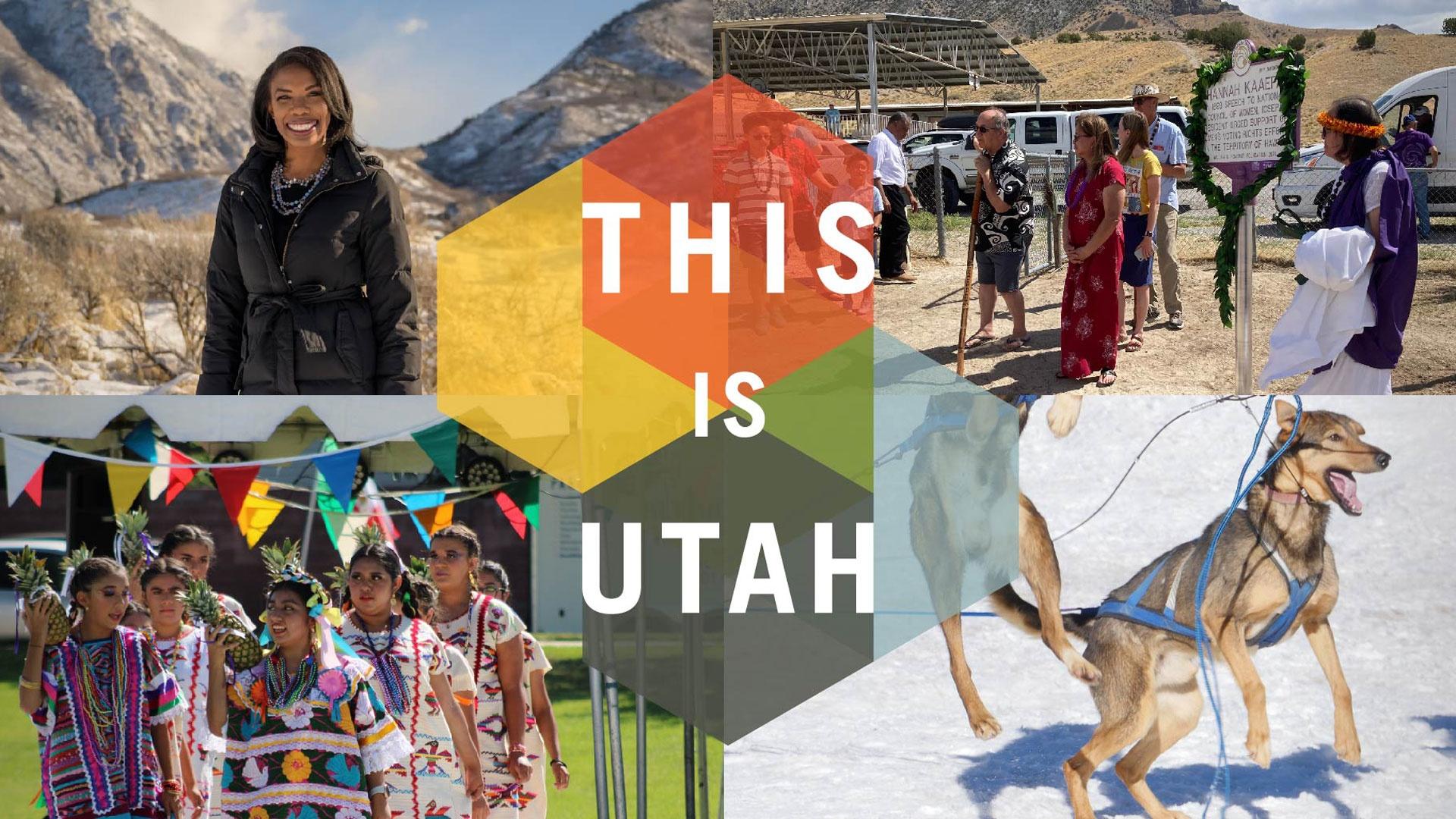
As part of its Many Faces, Many Voices diversity campaign, KUED-Channel 7 presents a new half-hour exploration of the changing landscape of Utah's population.
Created by Colleen Casto and co-producer Elizabeth Southwell, in 1992, The Faces of Utah takes an uplifting, celebratory look at the many layers of local diversity, with emphasis on race/ethnicity, religion, and age.
Taking viewers across the Wasatch Front, the program visits a Spanish Fork Hare Krishna temple and the Japanese Church of Christ in Salt Lake City to explore religious diversity; travels to Davis County's Antelope Elementary to find diversity education; meets with the elderly at the Olympus Hills Senior Center; learns how to tackle prejudice at Camp Anytown in Ogden Canyon; and talks with Hispanic Utahns about what it's like to be part of the largest ethnic minority group in the state.
The Faces of Utah tracks the changes taking place among different generations of minorities. David Galvan and Maria Garciaz grew up in the state during the 1960s and ‘70s and are now raising their own children. "Trying to preserve and pass on some of our culture to our children is extremely important, and we're cognizant of it almost daily," says Galvan. "We need to give them as much knowledge as we can about their culture, so they'll feel comfortable and proud of it. So they can walk out into the world strong."
Moving south along the Wasatch Front, the program travels to Spanish Fork, where Caru Dask and Vaibhavi Devi are building a Hare Krishna temple. "We've been able to assert that we're here for a particular purpose to benefit people, not to convert people or to change anything, but to try and give them the option of adding Hare Krishna principles to their own religion," says Caru. As more people like Caru and Vai move to Utah from various religious backgrounds, the number of non-L.D.S. members in Utah grows. The program explores such religious minorities and celebrates medley of religions that flourish in Utah. "We haven't felt any bigotry at all," says Vai. "We've been very fortunate to have made very good friends with the Mormon people in the area."
Looking to the future, the program spotlights education as key to understanding the many faces and many voices that comprise the Utah experience. At Antelope Elementary School in Clearfield, Jennifer Pizzello's class studies the Japanese-American internment camps during World War II. While learning history and honing their reading, writing, and spelling skills, the children are discovering a culture and learning how to respect differences among people.
"All of our children need to know to be able to respect other cultures. We all have to live together to be global citizens...because that's where our kids are headed out into the world," says Pizzello.
Because Utah is home to the the seventh most rapidly increasing elderly population in the nation, Utah's Many Faces also explores age diversity. By the year 2020, the number of Utahns over the age of 65 will have increased by 90.4 percent. David Turner, M.Ed., Centers Program Manager with Salt Lake County Aging Services, looks forward to the growing number of aging Baby Boomers, "Can you imagine we are going to have rock ‘n' rollers who are senior citizens! ...Mick Jagger could eat lunch at a senior citizen's center. Think about it Paul McCartney's not far away," he says.
At Anytown Camp in Ogden Canyon, young adults who will one day be senior citizens themselves learn about fighting bias and bigotry by respecting others. Teens like Elizabeth Flink learn to celebrate the differences among people. "Anyone who says [Utah is] not diverse hasn't looked around much," she says.
The Faces of Utah is made possible in part by a generous grant from Norman and Barbara Tanner.
Array
(
[area] => productions
[action] => details
[id] => 75
)
Array ( )